Precision Diagnostics, Health Infrastructure and Diagnostic Sovereignty
Every clinical decision begins with a question. Is this cancer? Will this treatment work? Is the disease progressing? Can it be detected earlier? Should we intervene now or wait? Diagnostics exist to answer those questions. They sit beneath almost every aspect of modern healthcare. Precision medicine, oncology, transplantation, infectious disease, population screening, public health, laboratory medicine, and increasingly artificial intelligence, all depend on the ability to generate accurate biological information at the right time. Diagnostics are the information infrastructure underlying precision medicine, modern healthcare, and increasingly national health resilience.
Yet diagnostics remain one of the least understood, least celebrated, and most strategically neglected parts of healthcare. The public sees hospitals. Investors see therapeutics. Policymakers see healthcare systems. But beneath them all sits an information layer that determines what decisions become possible. That information layer is diagnostics.
Over the past three decades I have worked across many parts of this world: academic research, computational genomics, liquid biopsy, precision oncology, clinical laboratories, diagnostics product development, regulation, venture creation, investment evaluation, capability building, and health innovation infrastructure. The more experience I accumulated, the more convinced I became that diagnostics are not simply another healthcare sector: they are its supporting infrastructure.
The ability to generate, interpret, validate, manufacture, regulate, deploy, and continuously improve diagnostic information is becoming a strategic capability for nations, institutions, health systems, and companies alike. This conviction guides much of my work today.
The Diagnostics Development Continuum
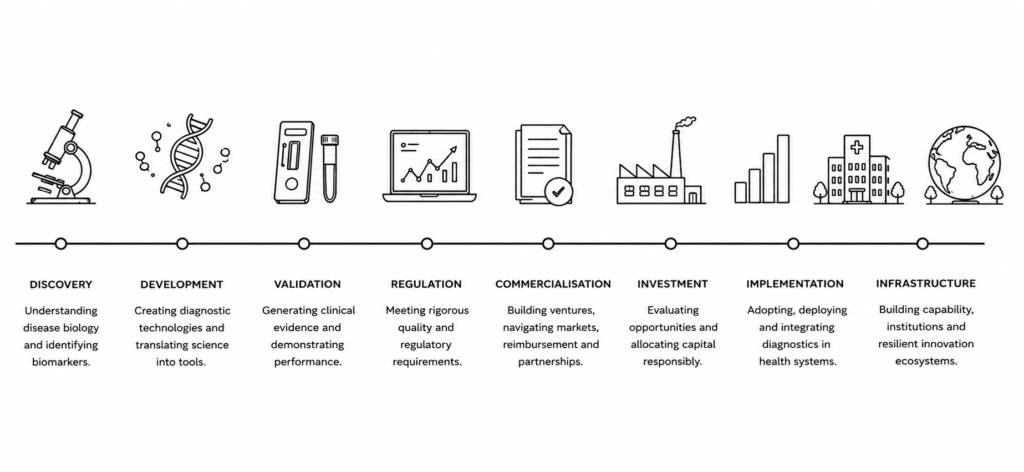
Most discussions about diagnostics focus on a single stage of the journey: discovery, product development, regulation, investment, or healthcare implementation. But in reality, impact only happens when all of these stages connect successfully.
A promising biomarker is not yet a diagnostic. A validated diagnostic is not yet a business. A successful company does not automatically improve healthcare. And strong healthcare systems ultimately depend on institutions, capabilities, and infrastructure that extend far beyond any individual product. The continuum below illustrates the journey from scientific discovery to health-system impact, and the interconnected decisions required at each stage.
My Perspective
Few people have worked across the full diagnostics continuum. My experience spans scientific discovery, product development, validation, regulation, commercialisation, investment evaluation, implementation, and ecosystem building.
Discovery. My scientific career began in genomics, bioinformatics, and translational research. Following doctoral and postdoctoral training in Portugal, the United Kingdom, and the United States, I spent more than twelve years leading a computational genomics research group at the Instituto Gulbenkian de Ciência. My work spanned disease biology, evolution, multi-omics data integration, and bioinformatics tool development, contributing to 67 publications, more than 9,500 citations, and an h-index of 39. Research projects and collaborations touched multiple areas of human health and disease, including liver cancer, liver transplantation, diabetes, tuberculosis, antimicrobial resistance, COVID-19, human genetics, and eye disorders.
Development, Validation, Regulation & Commercialisation. Scientific discoveries only create impact when they become products, services, or technologies that reach patients. My journey into translation began with Comparagen, a drug repositioning venture exploring new antimicrobial opportunities. It continued with the creation of Portugal’s first dedicated clinical oncogenomics company, where we introduced liquid biopsy services at a time when the technology was still largely absent from routine clinical practice in the country, as reflected in early national coverage by Diário de Notícias. I later founded and led Ophiomics, an EIC Accelerator-backed precision diagnostics company focused on liver disease. There I experienced the complete journey from scientific concept to regulated product, including clinical validation, CE marking, UKCA marking, ISO 13485 quality systems, manufacturing, fundraising, partnerships, and international commercialisation.
- Many of the lessons learned during this phase are captured in my book, Precision Diagnostics: A Founder’s Journey.
- During this period I also helped establish and lead Portugal’s first health-focused business incubator, Healthcare City, where I designed and directed the first acceleration programme dedicated to health innovation.
- Today, through HealthTech Qatar, I am working to make this journey easier for future founders by building execution infrastructure that helps health innovations move more successfully from concept to market.
Investment & Evaluation. Having raised both equity and non-dilutive funding, built ventures, reviewed opportunities, and worked with investors and funders, I became increasingly interested in how diagnostic opportunities are evaluated.
- This led to the development of the Diagnostics Readiness Levels (DRL) framework, a structured methodology for assessing diagnostics opportunities across scientific, clinical, regulatory, commercial, and strategic dimensions.
Implementation. Diagnostics only matter when they influence decisions. Throughout my career I have worked closely with hospitals, laboratories, translational programmes, clinicians, health systems, and innovation agencies, helping technologies move from scientific promise into real-world adoption. This experience reinforced a simple lesson: success is not determined solely by the quality of a technology, but by its ability to fit within clinical workflows, procurement systems, reimbursement environments, and healthcare infrastructure.
Infrastructure & Capability. Beyond individual products lies a broader question: how do organisations, ecosystems, and countries build diagnostic capability?
- At the educational level, I have supervised doctoral and master’s students, contributed to postgraduate programmes, taught specialised bioinformatics courses, delivered executive education, and worked with scientists, clinicians, entrepreneurs, and innovation leaders across multiple stages of their careers. I am now developing additional capability building portfolio (more soon).
- At the institutional level, I drove the building of BioData.pt, Portugal’s national biological data infrastructure, and contributed to its integration within ELIXIR, Europe’s life-science data infrastructure. I also served on the Scientific Advisory Board of Taguspark and worked extensively with universities, research institutes, and innovation programmes.
- At the ecosystem level, I served as Vice-President of P-BIO, Portugal’s biotechnology industry association, contributing to sector development initiatives and national strategy discussions, including the In Vitro Diagnostics Roadmap for Portugal and the BioHealth 2030 Strategy.
- Today, my work increasingly focuses on the larger systemic questions surrounding diagnostics capability, health innovation infrastructure, and diagnostic sovereignty. These themes are explored in depth in my book The Import Condition, which examines how countries and regions can build more resilient diagnostic ecosystems, strengthen supply chains, and reduce strategic dependence in critical areas of healthcare.
How I Engage
Today I work selectively with investors, ventures, institutions, and ecosystem builders building capability in diagnostics, precision medicine, and health infrastructure.
Investors, Funders & Capital Allocators. Helping investors evaluate diagnostics, genomics, AI-enabled diagnostics, laboratory businesses, and health infrastructure opportunities. This is for family offices, venture funds, strategic investors, sovereign and sovereign-linked entities, innovation agencies, and other organisations seeking a grounded assessment of whether an opportunity is scientifically credible, commercially viable, and worth pursuing.
Typical advisory engagements
- Diagnostics Rapid Investment Screen – A focused assessment of a single opportunity to determine whether further diligence is warranted.
- Diagnostics Investment & Commercialisation Review – An in-depth review across scientific, clinical, regulatory, commercial, and strategic dimensions.
- Diagnostics Portfolio Review – Comparative assessment of multiple companies or opportunities to support portfolio management and capital allocation decisions.
- Investor Advisory – Ongoing access to diagnostics and health innovation expertise for opportunity assessment, portfolio support, strategic discussions, and rapid second opinions.
- Most engagements begin with a conversation around a specific opportunity, challenge, or investment question. Detailed scopes, deliverables, timelines, and fees are discussed once the context is understood.
Leadership Teams & Boards. Supporting ventures and organisations navigating strategy, validation, regulation, commercialisation, growth, and international expansion. This is for teams facing decisions on validation, regulation, commercialisation, or expansion. Examples include strategic advisory, fractional leadership roles, board participation, growth and commercialisation support.
Universities, Accelerators & Innovation Programmes. Capability development and practical education around diagnostics innovation. This is for institutions trying to move from “we like innovation” to “we can actually build diagnostics ventures. Examples include workshops, executive education, venture-building programmes, innovation evaluation frameworks.
Institutions & Ecosystem Builders. Design and review of programmes, platforms, and innovation infrastructure. This is for for actors designing or reassessing programmes, platforms, or localisation initiatives. Examples include accelerator design, translational programmes, diagnostics localisation initiatives, capability platform development.
Strategic Papers & Convenings. Commissioned reports, white papers, executive briefings, and high-level discussions on diagnostics, precision medicine, and health innovation. This is for bodies needing to frame a question, align stakeholders, or anchor a conversation. Examples include strategic reports, position papers, conference and summit architecture, stakeholder alignment processes.
A Conversation First
Most engagements begin with a conversation around a specific challenge, opportunity, or strategic question. If you are working in diagnostics, precision medicine, health innovation, or health infrastructure and believe there may be a useful overlap, I would be pleased to hear from you.