Saudi Arabia’s quiet LDT move is bigger than it looks
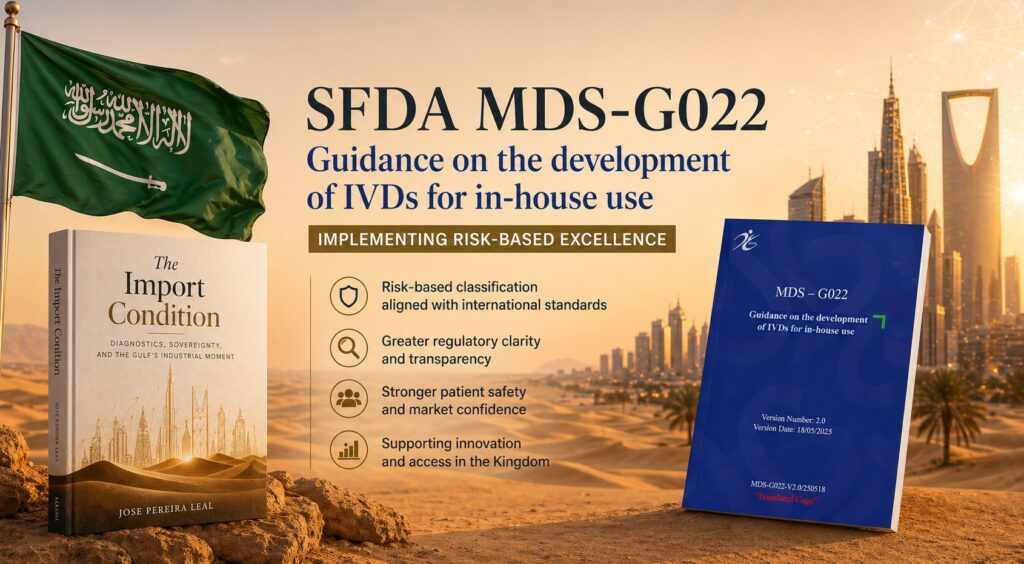
The MDS-G022 lays the foundation for a GCC-wide in-house IVD framework. This matters for diagnostics sovereignty and early commercial development in the Gulf
In May 2025, the Saudi Food and Drug Authority published Version 2.0 of MDS-G022, its guidance on in-house IVDs. Most commentary has treated it as a compliance update for lab managers. I want to argue it is significantly more important than that, a point I develop at length in my current book on diagnostics sovereignty and the Gulf’s industrial moment.
What SFDA actually built
MDS-G022 is a mini-regulatory system for LDT-like activity inside hospitals, embedded directly in device law. A brief definition is useful here: a laboratory-developed test, or LDT, is an in vitro diagnostic test that is designed, manufactured, and used within a single clinical laboratory, rather than being mass-produced and distributed as a commercial kit. The FDA defines it as an IVD “intended for clinical use and designed, manufactured, and used within a single laboratory.” [1, 2] In other words, a test a laboratory builds and runs itself, rather than buying off the shelf.
Under MDS-G022, in-house IVDs are defined, scoped, and brought under the same Essential Principles that govern commercial devices, without requiring a full marketing authorisation for non-commercial use. The guidance requires a real quality management system: design controls, production records, analytical and clinical performance data generated on patient samples, post-market surveillance. ISO 13485, ISO 15189, ISO 14971, and ISO 22367 are all explicitly referenced.
This is not a light-touch exemption. It is a named regulatory category with audit trail and regulator visibility. SFDA has moved LDT-style practice from a grey zone into something SFDA can learn from, inspect, and build on. Saudi Arabia is the first GCC state to give lab-developed assays formal regulatory identity under device law.
Three implications worth drawing out
First: in-house capability as a health security asset. MDS-G022 gives Saudi tertiary laboratories a clear mandate to build and maintain diagnostic capacity on top of their existing PCR and NGS platforms, with the regulator informed rather than blind to what is running. That is the precondition for treating in-house capability as a planned health security asset rather than tolerated improvisation. In a region that experienced acute diagnostic supply pressure in 2020 and is now yet again facing supply chain disruption, this is not an abstract point.
Second: a framework that can travel. MDS-G022 is written in technical language anchored in international standards. Its reference framework is device-law based, ISO-aligned, and IMDRF-compatible. Extending it to a GCC-wide in-house IVD regime through the Gulf Health Council’s existing harmonisation machinery is a policy step, not a technical redesign. Saudi Arabia has done the design work. It is now up to the rest of the GCC to treat MDS-G022 as more than a Saudi-specific quality instrument: as the prototype of a regional architecture.
Third: the missing commercial on-ramp. This is the argument I find most consequential. In the United States, CLIA-certified laboratories served for decades as the first commercial deployment environment for novel molecular tests. A company developing a new assay could launch it as a laboratory service, generate real clinical evidence on real patients, build institutional relationships, and establish a revenue base before pursuing full commercial device registration. That pathway is how a substantial part of the US molecular diagnostics sector grew. The EU has never provided an equivalent, and the IVDR has made the situation more restrictive, not less: Article 5(5) nominally permits in-house devices but its conditions make it functionally inaccessible for most institutions attempting systematic in-house testing.
MDS-G022 is not yet CLIA. Its framing is quality-and-safety governance for hospital practice, not explicit recognition of in-house operation as an early commercial pathway. But the architecture is there. The distance between what Saudi has built and what a full GCC in-house IVD commercial framework would provide is a policy decision, not a technical gap.
Why this matters for European companies looking at the Gulf
The research infrastructure is already in place across the GCC: national genome projects, population biobanks, precision health institutes. What has been missing is a clear regulatory path from research data to clinical deployment to commercial scale. MDS-G022 is the first piece of that path being formalised.
For a European diagnostics company developing a novel molecular assay, whether a liquid biopsy, an infectious disease panel, or a pharmacogenomic test calibrated to Gulf population genetics, a functioning in-house IVD framework changes the entry logic entirely. Clinical deployment through a Saudi partner laboratory becomes a real first step, not a regulatory grey area. Gulf population validation data, unavailable anywhere else, becomes accessible through a defined pathway. And the route to full commercial registration, whether through SFDA directly or through a future GCC mutual recognition instrument, is clear from the outset.
A beginning, not an endpoint
Gulf health systems have invested seriously in research infrastructure. They have world leading genome projects, operational and ambitious biobanks and world-class clinical centres. What converts those assets into a diagnostics industry is the regulatory architecture that connects them. MDS-G022 is the first piece of that architecture being put in place.
The Gulf Health Council has the harmonisation machinery to extend it. Pairing a GCC-wide in-house IVD framework with a unified market approval pathway, a Gulf IVD Mark, would give early-stage diagnostics companies something no other region currently offers: Gulf population data, a clear regulatory on-ramp to clinical deployment, and a path to a market of over 60 million patients under a single approval. What remains is the political decision to treat in-house IVD capacity as a named component of regional health security and early industrial development, not as a laboratory quality matter.
That decision would make the Gulf a more attractive place to build early-stage diagnostics companies than Europe currently is. That is not a small thing.
This article draws on research for my second book on diagnostics, sovereignty, and the Gulf’s industrial moment. SFDA MDS-G022 v2.0 was published May 18, 2025.
References
[1] US Food and Drug Administration. Laboratory Developed Tests. 2025. https://www.fda.gov/medical-devices/in-vitro-diagnostics/laboratory-developed-tests
[2] US Centers for Medicare and Medicaid Services. CLIA — Laboratory Developed Tests: FAQs.https://www.cms.gov/regulations-and-guidance/legislation/clia/downloads/ldt-and-clia_faqs.pdf
MDS-G022 (already present, well-placed)laboratory-developed tests GCCin-house IVD regulation Saudi ArabiaSFDA in-house diagnosticsGCC diagnostics sovereignty