The Localisation Trap: GCC Needs a Regional Diagnostics Strategy, Not Six National Ones
Over the past several weeks I have been reading the many analyses coming out of Gulf policy circles. Carnegie’s three scenarios for GCC states after the Iran war. The Al Jazeera opinions arguing that joint defence and integrated development are now the only credible regional agenda. The Middle East Council’s assessment of Qatar’s strategic position after Ras Laffan. The calls for a Gulf NATO, for shared energy corridors, for rail links that bypass Hormuz. A whole cluster of serious people, writing from inside the region, converging on the same conclusion: the Gulf cannot continue to outsource its strategic infrastructure to external guarantors – security, energy transit, trade logistics – and call it stability.
I noticed that none of them are talking about diagnostics. But when Hormuz became uncertain and freight into Gulf ports and airports unpredictable, my immediate reaction was looking at reagent lead times, worrying that every single reagent that I need in Qatar is imported, has a single geography of origin and a single route in.
The GCC’s clinical laboratory system and consequently its health system, its genome programmes, and allied laboratory activities in food security and environmental monitoring runs almost entirely on imported enzymes, plasticware, test kits, and instruments manufactured in Germany, the United States, and increasingly China. Those supply chains run through the same chokepoints the USA/Israel and Iran have been fighting over. No one targeted the diagnostics supply chain specifically, but this is a casualty of this conflict, having no independent infrastructure to stand on.
Every commentator is drawing what I believe to be the correct lesson about security alliances and energy corridors. Diagnostics supply chains are in the same category and I fear that no one is saying so clearly. That is my point in writing this article.
The GCC has built something remarkable. Saudi Vision 2030 targets 80 percent pharmaceutical localisation. NUPCO now rejects foreign bids where qualified local alternatives exist. The UAE’s ICV programme redirected AED 67 billion toward domestic suppliers in 2023 alone. Oman has a Mandatory List. Every GCC state is pulling manufacturing inside its borders. All of this aiming to increase localisation and resilience, but almost none of it applies to diagnostics.
The GCC in-vitro diagnostics market runs to several billion dollars annually, with reagents and consumables accounting for roughly 60 percent of total spend. Saudi Arabia’s clinical laboratory sector alone generates over a billion dollars in annual revenue. Six simultaneous national genome programmes are consuming sequencing consumables at scale. Every consumable is imported.
That is the paradox: the Gulf has built sovereign-scale demand on top of a supply chain it does not control.
The problem: local means national
Every current GCC local content framework defines “local” at the national level. A PCR reagent manufactured in Doha earns nothing in a Saudi tender. A kit assembled in Jeddah does nothing for an Emirati ICV score. Politically, this is logical as these frameworks were designed to build national industry. But diagnostics manufacturing does not scale nationally. Below certain volumes, enzyme production, oligo synthesis, and QC infrastructure become structurally uncompetitive. The economics do not respect political borders.
The consequence is now visible: six states, each incentivised to build parallel capability across the same long supply chain, none reaching the volume that would make a regional manufacturing base genuinely competitive with global incumbents. This is not how you build a resilient value chain.
GCC capitals are currently debating integrated air defence systems and joint infrastructure corridors on the grounds that no single state can secure them alone. The same logic applies to enzyme production, oligo synthesis, and QC infrastructure; the threat vectors differ, but the regional vulnerability is identical.
Saudi Arabia has a choice to make
It is self-evident that Saudi Arabia is the anchor. It has the market scale, the procurement leverage, the sovereign capital, and the policy ambition to lead a GCC diagnostics manufacturing build. Vision 2030’s pharmaceutical localisation instinct is correct as a strategic direction.
But Saudi Arabia can build the GCC’s first truly competitive diagnostics manufacturing base, anchoring the high-value layers in-country, while letting and encouraging aligned neighbours develop adjacent layers at coordinated scale. Or it can pursue full-stack national self-sufficiency in isolation and unintentionally lock the entire region into six sub-scale supply chains, none competitive, all fragile, while shouldering the full investment required on its own.
The timing however must be now. The Middle East Council’s recent analysis of Qatar’s strategic position makes the point plainly: the political conditions for accelerated intra-GCC economic integration are more favourable now than at any point since the organisation’s founding. The window will not remain open once the immediate pressure of the conflict recedes. The same window applies to diagnostics industrial strategy.
The political friction is real; ignoring it solves nothing
The three-move compact I am about to propose is not complicated in principle, but it asks for cooperation, which has traditionally not been easiest in the region.
No procurement authority wants to dilute national preference. No ministry wants to explain to its leadership why a competitor state’s factory counts toward national industrial targets. This resistance is institutional and structural, reinforced by frameworks established in other sectors; they are not going to be rewritten for diagnostics unless the argument is made explicitly and forcefully.
But I argue that a Saudi-only diagnostics production base is still a single point of failure. A UAE-only base is another single point of failure. Six sovereign supply chain strategies, none at competitive scale, replicate the external dependency they aim to eliminate, just with different flags on the factories. Driving for a national value chain will not build sovereignty: it is the same fragmentation problem, just onshored.
The minimum that every state still needs
None of this is an argument for smaller states to free-ride on Saudi ambition. Every state needs a minimum diagnostics sovereignty capability: stockpile and rotation capacity for critical tests, domestic batch-release and QC capability, enough manufacture infrastructure to keep essential services running when cross-border logistics are disrupted. Larger or smaller disruptions of supply chains and cross-border logistics have plagued the Gulf, so this is not an abstract danger, but a lived reality. Individual states cannot outsource those minimal capabilities without outsourcing sovereignty itself.
A diagnostics compact for the GCC
I believe three moves can change the game: a shared GCC definition of what diagnostic capabilities must exist somewhere inside the regional perimeter, developed through the Gulf CDC framework; a second tier of “regional content” in procurement rules, so that intra-GCC sourcing is not penalised relative to strictly domestic supply; and some level of coordination of industrial incentives that steer each country toward supply chain layers where it has genuine comparative advantage, rather than pushing every state to replicate the same full stack.
The logic is identical to what is now being urgently argued for GCC security and logistics architecture: regional interdependence is a strength, not a concession. A reagent manufactured in Qatar that substitutes for one from the USA when Hormuz is closed is a strategic asset. Six national frameworks that each import from the USA and call it localisation is not.
A purely national race for local diagnostics production will leave the GCC with six sub-scale supply chains and no real resilience. The alternative is harder politically but stronger strategically: Saudi leads, neighbours specialise, every state secures a minimum capability at home.
I am deeply convinced that this is not a concession. It is what a serious sovereignty strategy looks like in a region that already shares patients, pathogens, and supply routes, and has just been reminded, at considerable cost, what happens when the infrastructure those routes carry is not treated as strategic.
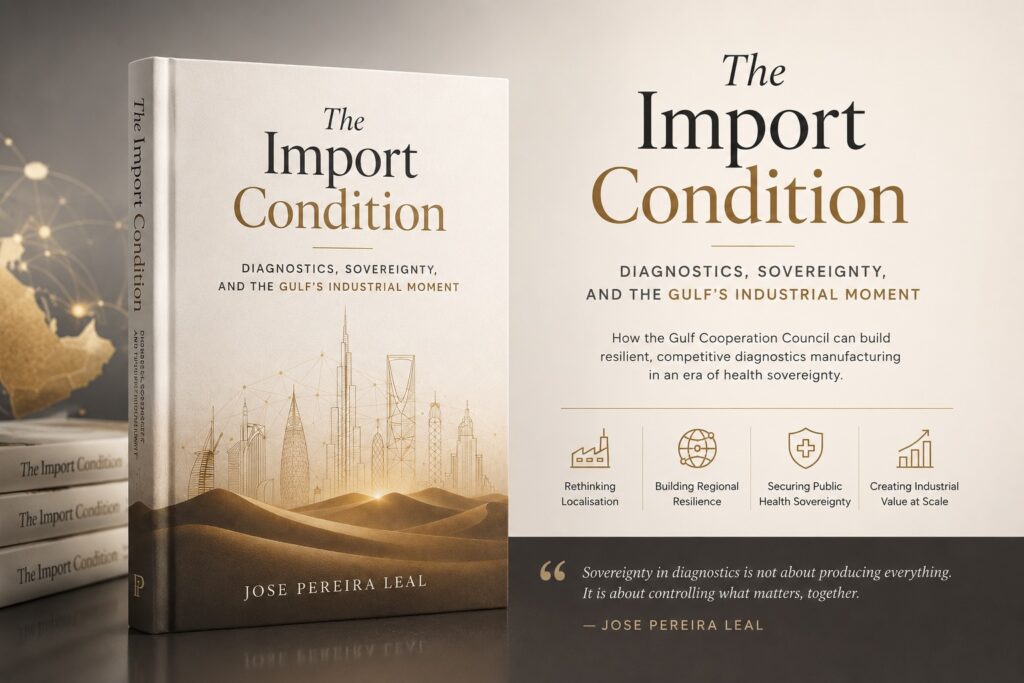
This article draws on research for The Import Condition: Diagnostics, Sovereignty, and the Gulf’s Industrial Moment (forthcoming 2026.)
Source References
Geopolitical context (post-war GCC integration debate)
- Al-Mudahka, Faisal Abdulhamid. “The GCC has unity, it now needs joint defence and development.” Al Jazeera, 19 April 2026. https://www.aljazeera.com/opinions/2026/4/19/the-gcc-has-unity-it-now-needs-joint-defence-and-development
- Carnegie Endowment. “Three Scenarios for the Gulf States After the Iran War.” 15 April 2026. https://carnegieendowment.org/emissary/2026/04/gulf-states-gcc-iran-war-three-scenarios
- Schneider, Frédéric. “Qatar’s Strategic Balancing Amid Escalation and Disruption.” Middle East Council on Global Affairs, 4 May 2026. https://mecouncil.org/publication/qatars-strategic-balancing-amid-escalation-and-disruption/
- Chokr, Hussein. “It does not make sense to invest more Arab resources in a US alliance.” Al Jazeera, 3 May 2026. https://www.aljazeera.com/opinions/2026/5/3/it-does-not-make-sense-to-invest-more-arab-resources-in-a-us-alliance
- Al Jazeera News. “Gulf leaders meet in Saudi Arabia for first time since start of war on Iran.” 28 April 2026. https://www.aljazeera.com/news/2026/4/28/gulf-leaders-meet-in-saudi-arabia-for-first-time-since-start-of-war-on-iran
Diagnostics and localisation data
- Mordor Intelligence. GCC In-Vitro Diagnostics Market. 2024. https://www.mordorintelligence.com/industry-reports/gulf-cooperation-council-gcc-in-vitro-diagnostics-market
- Grand View Research. Saudi Arabia Clinical Laboratory Service Market. 2024. https://www.grandviewresearch.com/horizon/outlook/clinical-laboratory-service-market/saudi-arabia
- Grand View Research. Middle East and Africa Sequencing Reagents Market. 2024. https://www.grandviewresearch.com/horizon/outlook/sequencing-reagents-market/mea
- UAE Ministry of Industry and Advanced Technology. National In-Country Value Program (ICV). https://moiat.gov.ae/en/programs/icv
- Saudipedia. National Unified Procurement Company (NUPCO). https://saudipedia.com/en/national-unified-procurement-company-nupco
- Saudi Healthcare Consulting. NUPCO Tenders 2026 Force Pharma’s Local Awakening. 2026. https://saudihealthcareconsulting.com/insights/articles/nupco-tenders-2026-force-local-pharma-awakening
- Oman News Agency. Tender Board Launches Programmes to Promote Local Content. 2025. https://omannews.gov.om/topics/en/80/show/113903
- Gulf Center for Disease Prevention and Control. Gulf Public Health Emergency Preparedness Plan 2025–2030. December 2024. https://gulfcdc.org/en/Pages/Gulf-Public-Health-Emergency-Preparedness-Plan/Category/16