The Validation Tax
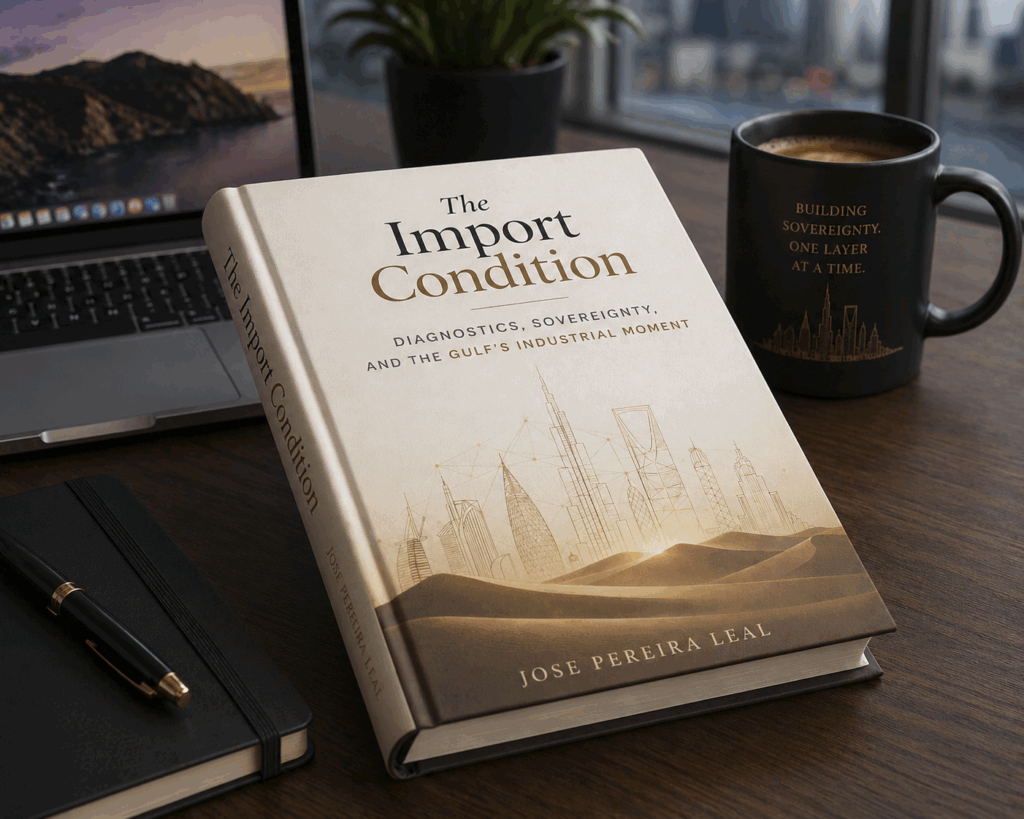
A note from work in progress: The Import Condition: Diagnostics, Sovereignty, and the Gulf’s Industrial Moment
There is a dependency in Gulf healthcare that does not appear on any customs manifest and generates no import tariff. It does not show up in the trade statistics for diagnostic reagents. It cannot be measured in tonnes at the port of Jebel Ali. It is, in that sense, the most invisible of the region’s import conditions, and probably the most consequential.
The dependency sits at the level of validation, a subject I have written about in detail elsewhere from the perspective of a developer. This piece takes that argument into different territory.
A large proportion of the diagnostic assays used in clinics from Riyadh to Muscat were calibrated on populations that are not Gulf Arab. The reference ranges were established on European cohorts. The genetic variants were validated against databases assembled overwhelmingly from participants of Northern European ancestry. The clinical decision thresholds (the cut-offs that determine whether a result flags concern or clears a patient) were derived from metabolic and comorbidity profiles that may not reflect what a laboratory technician in Doha or Manama actually encounters at the bench. This is not negligence. It is how the global diagnostics system evolved. But it has a specific consequence: the region is, in a precise technical sense, approximating its patients rather than diagnosing them.
I discovered this first hand.
Working on a liver diagnostics programme until recently, with assays at various stages of development and one already CE-marked, I needed samples from Gulf patients. The clinical profile was specific: patients with liver cancer in the context of hepatic fibrosis and steatosis in a population where non-alcoholic fatty liver disease runs at some of the highest prevalence rates in the world, with the metabolic comorbidity landscape that characterises the Arabian Peninsula. I knew the institution to contact. It had described itself, in published literature and at conferences, as a major resource for exactly this kind of research. The request I sent was credentialed, specific, and scientifically grounded. No one replied. I tried again. I tried through a contact who knew the team. The silence was complete.
The conclusion I drew was not that the institution had misrepresented its biobank. The assets very likely exist. The conclusion was simpler: the infrastructure exists, but the access layer does not. There is no governed, transparent mechanism by which a qualified external developer can submit a request and receive a response within a defined timeframe. The freezers are running; the samples are in them; the door to the building has no handle on the outside.
Contrast this with what I have experienced in Spain. The Red Nacional de Biobancos, built over roughly a decade across seventeen autonomous communities each with its own health system and institutional culture, operates as a single point of contact for any researcher or developer who needs samples. You contact the network; the network finds the samples; you access them under a harmonised governance framework. During COVID-19, this system made approximately 62,000 samples from 21,000 patients available across the country through a common registry. The Spanish system should not work as well as it does, given the institutional complexity underneath it. It works because someone spent a decade building the governance layer.
The Gulf has substantial biobank assets, but it has not yet built the governance layer.
What changes when it does? The impact runs in two directions simultaneously.
For local developers, governed regional biobank access means that technical and clinical validation can be done on the populations the product will actually serve. Reference ranges set on Gulf biology. Clinical thresholds derived from the metabolic and comorbidity profiles of the people who will be tested. The first diagnostic tools that are not adapted to the Arabian Peninsula but born from it.
For the global industry, the implication is different and arguably more strategically significant. The Gulf is currently seen as a high-value market for diagnostics: sophisticated, well-funded, growing fast. A regional biobank network with structured, governed, commercially accessible cohorts changes that position entirely. Global genomics and diagnostics remain profoundly skewed toward European-ancestry populations. The first region to offer structured access to well-annotated, underrepresented cohorts at scale will not simply participate in the system of diagnostic evidence. It will become one of the places where that evidence is generated. The region moves from a market that buys validated products to a platform where products get validated. That is a different kind of industrial position.
The build is not primarily technical. The assets already exist: national cohorts, genomic programmes, modern clinical infrastructure, significant investment in data systems. What is missing is governance: harmonised access protocols, a transparent request mechanism, clear frameworks for commercial engagement, and a coordinating layer light enough to function without replicating the institutional friction that makes Europe’s BBMRI-ERIC impressive in scale but inaccessible in practice. Spain took roughly ten years. The Gulf has the advantage of starting later, with fewer structural constraints, and with a more urgent industrial motivation.
I am exploring all of this in a book currently in progress: The Import Condition: Diagnostics, Sovereignty, and the Gulf’s Industrial Moment. The argument is that the Gulf has built world-class clinical infrastructure without building the supply chain that makes it sovereign. Diagnostics are the invisible foundation of every national health vision in the region, yet they appear in none of the six GCC industrial strategies as a named manufacturing target. That absence is simultaneously one of the region’s greatest fragilities and one of its most significant industrial opportunities, and the foundations for addressing it have already been laid.
The diagnostic value chain extends all the way down to the sample in the freezer. Until the access layer is built, a fundamental part of that chain remains external.
Who currently defines the biology your health system runs on?